
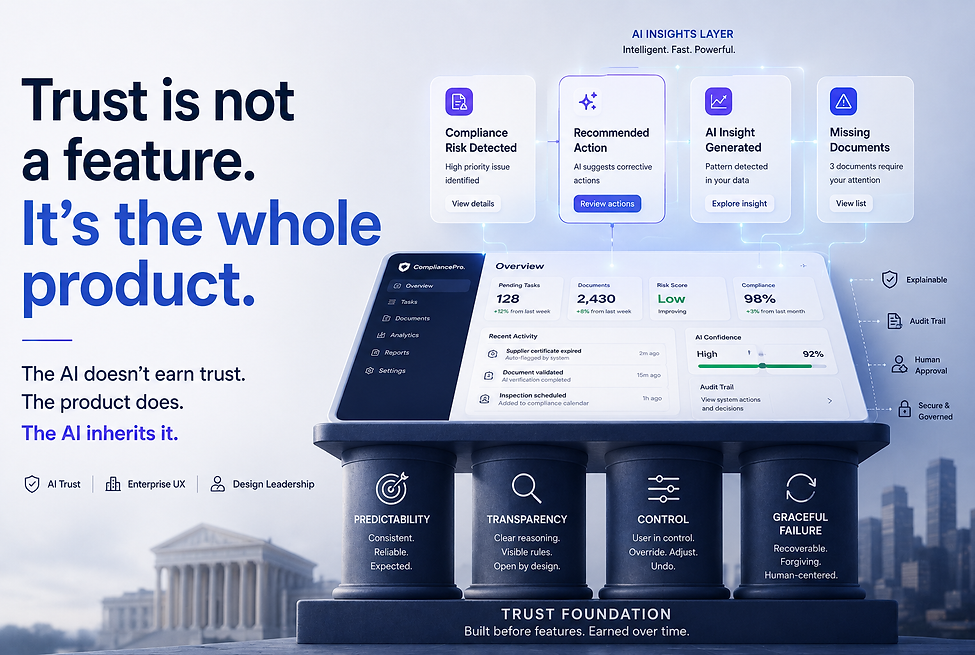
Trust is not a feature. It's the whole product
AI Trust
Enterprise UX
Design Leadership
When I was redesigning a compliance platform for 30,000 businesses regulated by the FDA, the product team kept asking me the same question: "When do we add the AI features?"
My answer was always the same: "When users trust the platform enough to act on what it tells them."
They found that frustrating. I understood why. We had AI capabilities ready to ship. The pressure to launch was real. But I'd seen what happens when AI features land on a platform users don't yet trust — and it's not a product problem. It's a trust collapse that takes months to recover from.
An AI feature that users don't trust is a feature that doesn't exist. They'll see it, ignore it, and route around it.
What does trust actually look like in a product?
After 17 years designing enterprise systems — banking platforms, contract management tools, compliance ecosystems, oil & gas platforms — I've found that trust has four visible components. All four need to be present before any AI layer has a chance of working.
-
Predictability. Does the product behave the way users expect it to, consistently? Trust is built through repetition. If the platform surprises users — even pleasantly — it erodes confidence. Before adding AI unpredictability, the baseline experience must be rock-solid.
-
Transparency. Do users know what the system is doing and why? In compliance, a missing document flag means nothing if the user can't understand the rule it's flagging against. In AI, a recommendation means nothing if the user can't see the reasoning behind it. Transparency is not a nice-to-have — it's the mechanism through which trust is built.
-
Control. Can the user override, adjust, or reject what the system suggests? The moment users feel a product is acting on their behalf without their permission, trust breaks — and it breaks permanently. Every AI action needs a visible seam: what happened, why, and how to undo it.
-
Graceful failure. When the system is wrong — and it will be — does it fail in a way that the user can recover from? AI errors in high-stakes domains (compliance, legal, finance) can be costly. The question isn't whether the AI will be wrong; it's whether the experience handles being wrong in a way that maintains trust rather than destroying it.
At the FDA compliance platform, we spent the first six months establishing trust in the core platform — not shipping AI. We redesigned the dashboard. We fixed the search. We clarified status indicators. We made the data reliable. Only then did we introduce AI insights — and when we did, users adopted them at a rate that surprised even the product team.
The AI didn't earn that trust. The product did. The AI inherited it.
Trust is infrastructure. You build it before you build features. Every AI product team that skips this step pays for it later — usually in adoption metrics that never move
If you're designing an AI product: before you add the next AI capability, ask yourself — do users trust the platform enough to act on what it tells them? If the answer isn't a confident yes, that's your next design problem.
Where have you seen AI features fail because the underlying trust wasn't established first?